Reach Unmana at unmana@gmail.com.
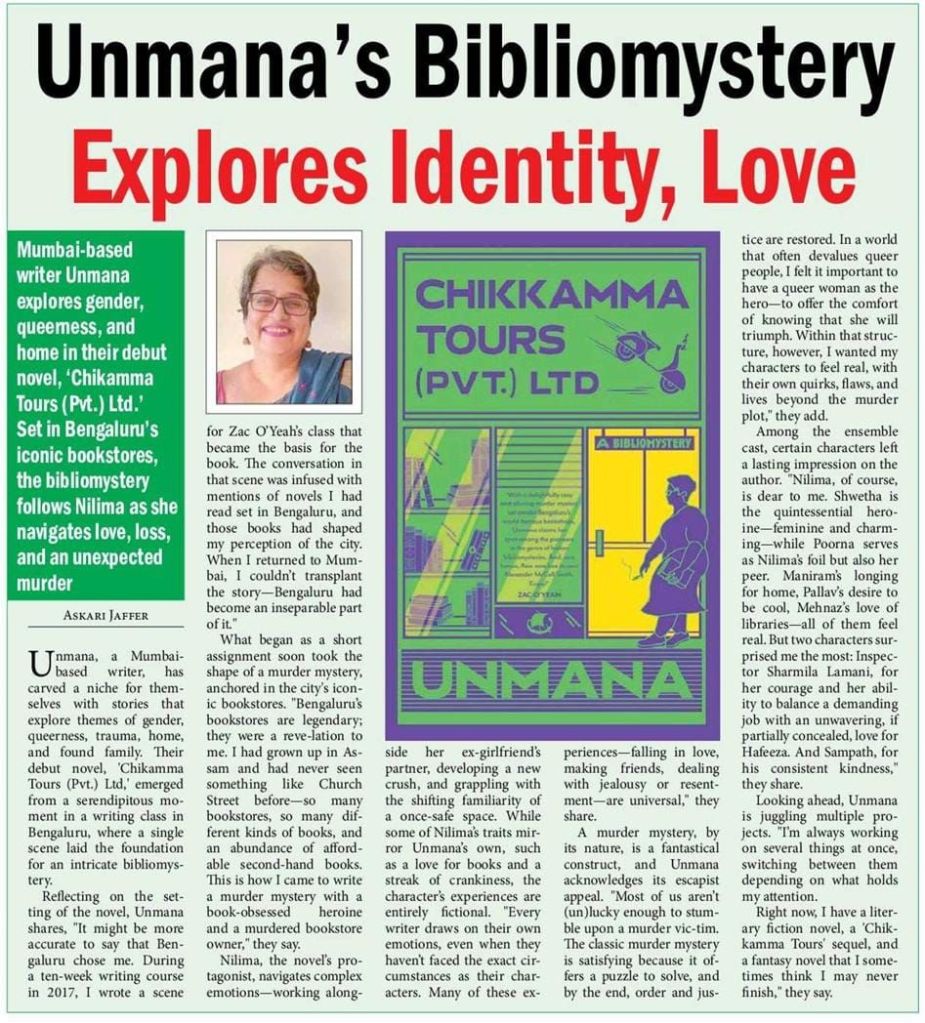
Chikkamma Tours (Pvt.) Ltd is a murder mystery set in Bengaluru.
When the owner of the bookshop above Chikkamma Tours gets stabbed to death, grumpy, book-obsessed, wise-cracking Nilima jumps at the opportunity to play amateur detective. With help from her boss Shwetha, whom she has a crush on, and Inspector Lamani, who is Nilima’s ex-girlfriend’s current girlfriend, Nilima investigates the murder, facing down angry bookshop employees, gangsters and sundry shady characters.
Unmana is one of “the pioneers in the genre of Indian bibliomysteries” and “Asia’s own Alexander McCall-Smith”. – Zac O’Yeah
“A cosy, suspenseful narrative that keeps you guessing… a book that feels alive and vivid… Its richly drawn descriptions, lively characters, and gripping mystery make it a novel that lingers in your mind.” – Scroll.in
Buy a signed copy from a Mumbai bookstore
Buy from a Delhi bookstore (ships worldwide)
Buy from Amazon (only in India)
Storizen includes Chikkamma in its list of 9 LGBT Indian books: “Packed with sharp wit, warm charm, and a healthy dose of queer chaos, Unmana’s debut is a cozy mystery with teeth—and plenty of heart.”
Cities in Fiction interviews Unmana on having their “protagonists walk, commute, work, and eat their way through the city.” An excerpt: “As I came out, I began to find myself surrounded by queer and gender non-conforming women… And it occurred to me that I hadn’t encountered any novels that featured characters like us: something seemed missing in the cultural portrayal of this moment in India… [The book reflects] the multiplicity of ways queer people find joy, comfort, friendship despite many constraints and much risk.”
On The Closet Writer Chronicles, Unmana talks about their writing process, why Chikkamma Tours took seven years to publication, and how Nilima is a classic noir detective —except she’s a short, fat lesbian. Listen on Spotify, Amazon or Apple.
Unmana tells Hans India: “In a world that often devalues queer people, I felt it important to have a queer woman as the hero—to offer the comfort of knowing that she will triumph.”
The New Indian Express: “The novel has gained attention for its representation of several queer women characters in a story that doesn’t make identity or coming out the sole focus, but gives them space to be heroines and side characters without pigeonholing them into the trope of a tortured villain.”
Hindustan Times: “The Chikkamma gang need to keep solving murders in many more future books.”
In the Free Press Journal: Unmana says, “Queer women have not solved fictional murders in Indian books before. I didn’t want my characters to be plot points or punch lines, I wanted them to feel like real people.”

Testimonials: “writing as a living, creative, joyous activity”
I loved the [Demystifying the Novel] workshop. It was the exact amount of non-intimidating yet highly insightful high level class I needed! – Vidya Gopal
It was a deeply transformative workshop. What an amazing session. – Ujjwala Kaushik
Unmana’s character development workshop was very detailed and helped in entering, thinking, writing through the complexity and layers of characters. It made the imagination of characters as human and grey feel as a real possibility. The emotions of the character and the writer writing them became alive in the workshop. With a range of literary resources and exercises, Unmana helped in understanding the multiple ways in which characters could be written, approached and how to still find centre through them in different kinds of writing (fiction, stories, non-fiction, essays). Unmana’s workshops in general, feel less writing pressuring and more as writing as a living, creative, joyous activity. To find a facilitator who can help centre the self and ease off the pressure even slightly, are really ones to be sought for. – Gurpreet
I found the [character development] workshop to be very comprehensive in its scope. I especially liked the bit where you shared the kind of questions we should be able to answer wrt our characters. It added more gravity to the exercise of character development. I also found the last bit about how to write marginalised characters very thought provoking. Also, I loved the aesthetics of your presentation. – Ritika
So happy to have been a part of this cohort and looking forward to the next, there’s so much to learn from you and I can’t wait! – Kishan Gusani
“Gestating” in the 2023 Deodar-BLF Prize Anthology
Unmana’s story was shortlisted for the inaugural Deodar Prize and published in the anthology of the ten best stories.
To get the book, email info@deodarprize.com and pay for shipping only.
A spider is growing inside me. It stabs at my body with its eight legs and two pedipalp s poking for an opening. What if it stays inside, lays eggs, fills me with spiders. But it finds its way out, one tentative leg breaking through my vagina. Pain and revulsion shoot through me but I force my body to stay still so it will crawl out and scamper down the bed and out of the window. Is the window open behind the curtain? I try to push myself upright to look, and I wake up.

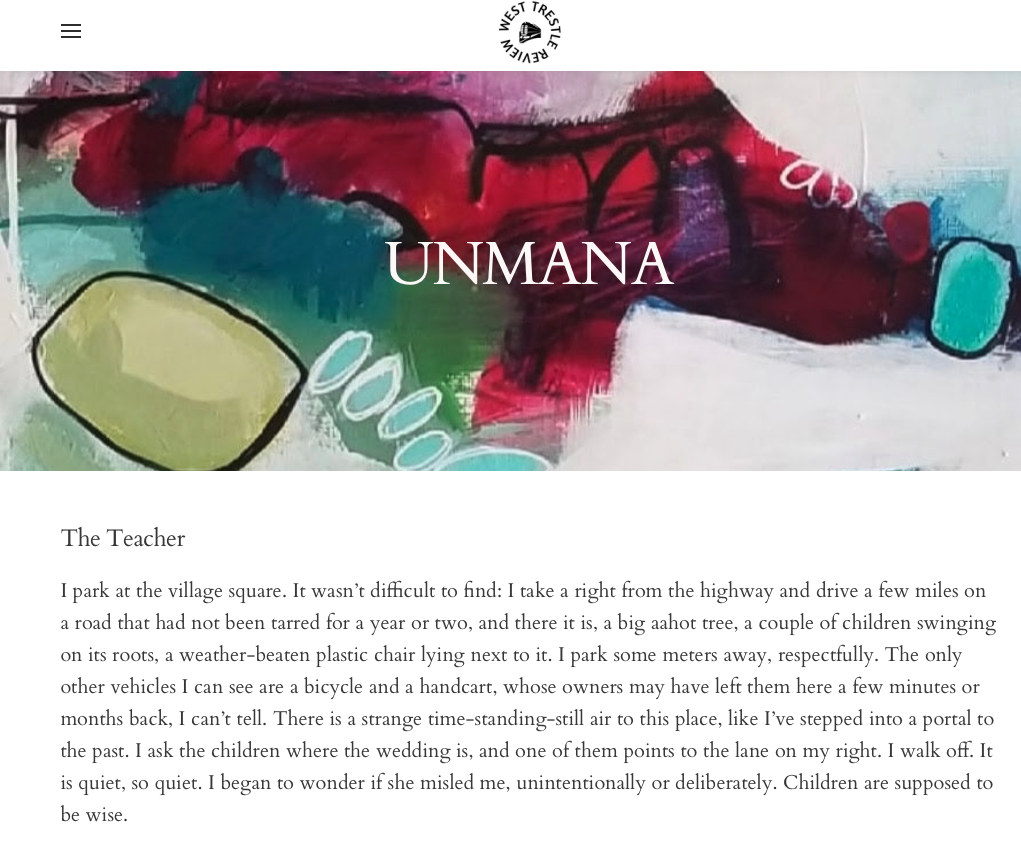
“The Teacher”, nominated for the Best of the Net
Unmana’s horror/fantasy story was published in the West Trestle Review.
I park at the village square. It wasn’t difficult to find: I take a right from the highway and drive a few miles on a road that had not been tarred for a year or two, and there it is, a big aahot tree, a couple of children swinging on its roots, a weather-beaten plastic chair lying next to it. I park some meters away, respectfully. The only other vehicles I can see are a bicycle and a handcart, whose owners may have left them here a few minutes or months back, I can’t tell. There is a strange time-standing-still air to this place, like I’ve stepped into a portal to the past. I ask the children where the wedding is, and one of them points to the lane on my right. I walk off. It is quiet, so quiet. I began to wonder if she misled me, unintentionally or deliberately. Children are supposed to be wise.
Poems
“I Want From Love” in the Broadkill Review:
the urgent grasping has become
a relaxing, a letting go with the utter safety of knowing
you’ll be caught each time.
“Instructions for Conducting a Raid in Kabaddi”, in the Roanoke Review, is an extended metaphor for the search for community.
“The End of Gender” appeared in Unbroken, and was republished in Only Poems’ Best New Poems. It is inspired by Ada Limón’s “The End of Poetry” and expresses the speaker’s frustration at binary-gendered language.
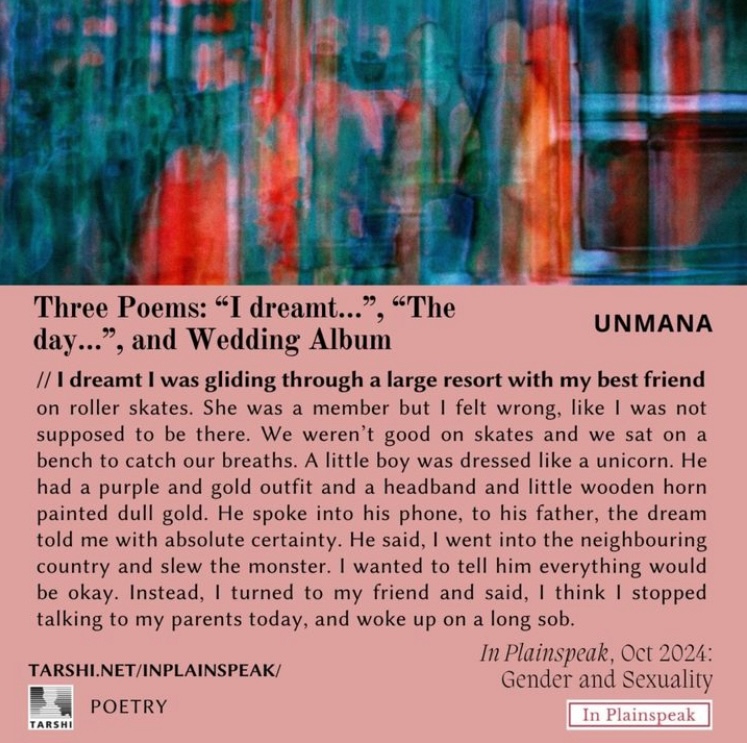
Three poems in In Plainspeak by Tarshi: “I dreamt I was gliding through a large resort with my best friend” is a transcript of a dream about belonging and unbelonging. “The day my first novel is announced” explores the metaphors of thin skin, snakes and venom, sticks and stones breaking bones, and how a trans person who hasn’t yet come out is referred to as an egg. “Wedding album” responds to a poem by Bhanu Kapil where the speaker gets married not in the wedding dress of her dreams but in a sari she had on hand.

Sign up for Unmana’s newsletter
My thoughts on feelings, relationships and writing.
Short pieces
How I wrote my first novel: it only took three decades.
I keep hearing that most queer books are sad. Here are some of my favourite queer books with happy endings.
A sampling of favourite queer romance novels.
A review of Night in Delhi by Ranbir Sidhu.
A review of Friend of My Youth by Amit Chaudhuri.
I will follow if I cannot lead, The Lord of the Rings fan fic.
What living with food intolerance taught me about dependence
Dealing with my intolerance to certain foods helped me to reject the judgment that had followed me all my life, an essay published in the anthology Skin Stories: Essays on Sexuality, Disability and Gender
 Unmana